

Beard Oil Market Set to Reach USD 3.31 Billion by 2035 as Natural Grooming and Online Retail Gain Momentum
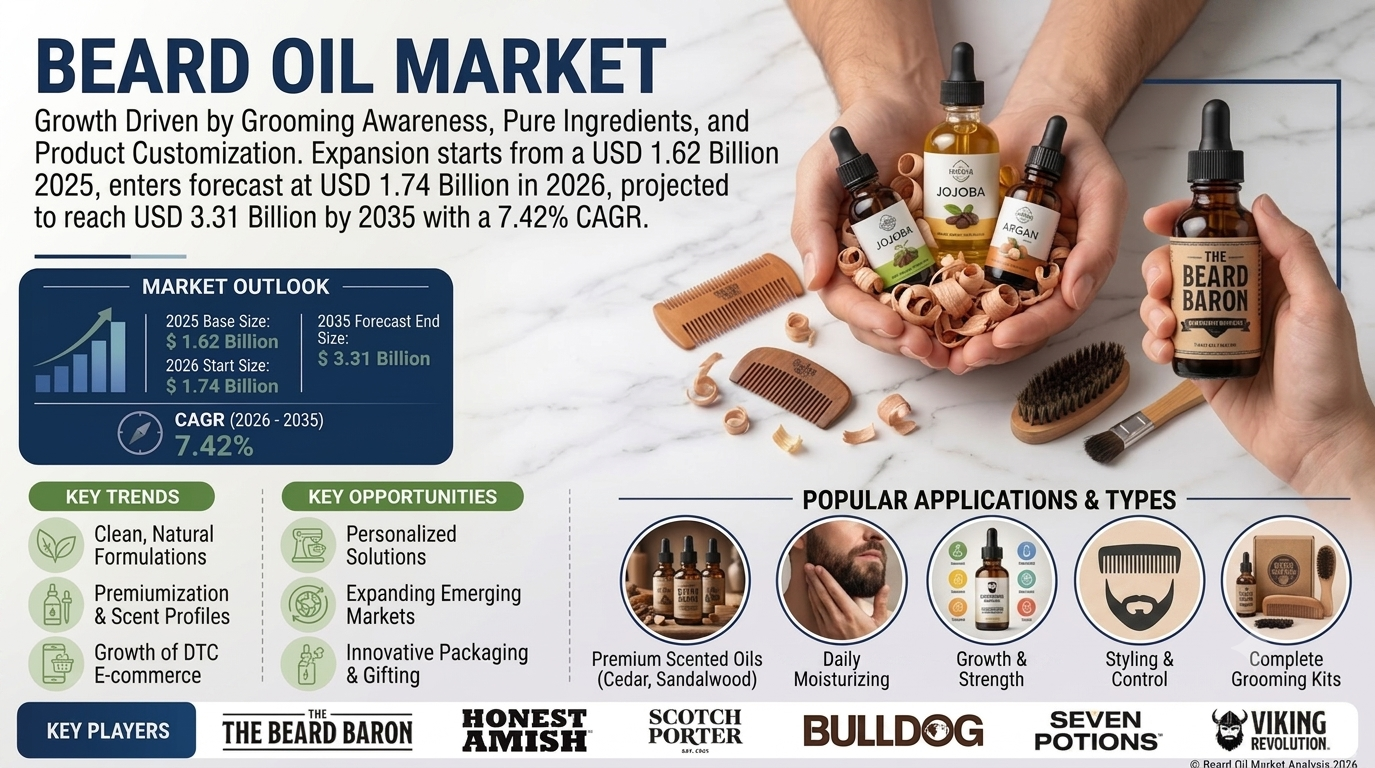
Beard Oil Market
Beard oil helps moisturize facial hair, nourish the skin beneath, reduce dryness and itchiness, and give beards a softer, healthier, well-groomed appearance.
Beard oil is becoming an essential grooming choice, helping men maintain softer, healthier, and well-conditioned facial hair.”
NEW YORK, NY, UNITED STATES, August 30, 2026 /EINPresswire.com/ -- The global Beard Oil Market is entering a period of sustained expansion as beard care becomes increasingly integrated into everyday personal grooming routines. According to the latest market assessment, the industry is valued at approximately USD 1.62 billion in 2025 and is expected to reach USD 1.74 billion in 2026, before advancing to USD 3.31 billion by 2035. The market is projected to register a 7.42% CAGR between 2026 and 2035, reflecting rising consumer interest in specialized grooming products and the continuing evolution of men's personal care.— Market Research Future (MRFR)
The market is being shaped by several simultaneous changes in consumer behavior. Beard maintenance has moved beyond basic trimming, with consumers increasingly seeking products designed to improve softness, manageability, appearance, fragrance, and overall grooming comfort. Beard oils have benefited from this transition because they can be incorporated easily into daily routines and are available across a broad range of price points, formulations, fragrances, and retail channels.
Competitive Landscape Remains Diverse:
The Beard Oil Market contains a combination of large multinational personal care companies, established grooming specialists, and smaller founder-led brands. This creates a competitive environment where scale and distribution are important, but brand authenticity and community engagement can also influence purchasing decisions.
Companies profiled in the report include:
▪️Edgewell Personal Care
▪️Procter & Gamble
▪️Unilever
▪️L'Oréal
▪️Beardbrand
▪️Marico
▪️Emami
▪️The Bluebeards Revenge
▪️Honest Amish
▪️Scotch Porter
▪️Captain Fawcett.
Large companies can leverage extensive distribution networks, established manufacturing capabilities, marketing resources, and broad personal care portfolios. Smaller brands can compete through distinctive formulations, specialist positioning, community-led marketing, direct relationships with consumers, and strong storytelling.
This creates multiple competitive pathways. Premium brands can focus on craftsmanship and heritage, natural brands can emphasize ingredient transparency, mass-market companies can compete through accessibility, and digital-first businesses can use personalization and community building.
Changing Men's Grooming Habits Create a Strong Foundation:
One of the most important factors supporting the Beard Oil Market is the growing acceptance of structured grooming routines among men. Consumers are becoming more attentive to personal presentation and are increasingly willing to use products targeted toward specific areas of grooming rather than relying exclusively on general-purpose personal care products.
Beard oil fits naturally within this development because it addresses several consumer needs through one product. Depending on its formulation, it can help condition facial hair, improve manageability, reduce the perception of dryness, and provide a more polished appearance. The product also appeals to consumers who view grooming as part of their lifestyle rather than an occasional activity.
The expansion of professional barbering and men's grooming culture has reinforced this behavior. Barbershops and specialty grooming establishments frequently introduce consumers to dedicated beard-care products, creating opportunities for product discovery and repeat purchases. Recommendations from grooming professionals can also influence consumers who are uncertain about which formulation or product type is appropriate for their beard.
As beard care becomes a more established category within men's personal care, manufacturers have greater opportunities to develop complementary products, including beard balms, washes, conditioners, combs, grooming kits, and specialized skincare products. This broader ecosystem can encourage consumers to treat beard oil as a regular replenishment product.
Natural Formulations Lead Product Preferences:
Natural products represent one of the strongest areas of opportunity within the global Beard Oil Market. Consumers are increasingly interested in formulations featuring recognizable botanical ingredients and plant-derived oils, particularly when brands provide clear information about sourcing, formulation, and product characteristics.
Natural beard oils can contain ingredients such as jojoba, argan, grapeseed, hemp, and other botanical oils. These ingredients are frequently positioned around conditioning and grooming benefits, while their recognizable names can make product labels more appealing to consumers seeking simpler formulations.
The natural category accounted for 58.6% of global revenue in 2025, making it the leading category in the report's segmentation. Conventional formulations remain important, particularly among price-conscious consumers and mass-market retailers, but natural products are benefiting from the broader clean-label movement across personal care.
The opportunity extends beyond simply adding botanical ingredients. Consumers increasingly expect brands to provide greater transparency around ingredient sourcing, processing, certification, and responsible production. Consequently, companies that combine natural positioning with credible documentation may be better positioned to differentiate their products in competitive retail environments.
Get Full PDF Sample Copy of Report: (Including Full TOC, List of Tables & Figures, Chart) @
https://www.marketresearchfuture.com/sample_request/29615
Report Scope:
The global Beard Oil Market study analyzes the industry across category, ingredient, distribution channel, and geography. The research covers the historical period from 2021 to 2024, uses 2025 as the base year, and provides forecasts through 2035.
The report estimates the market at USD 1.62 billion in 2025, with a projected value of USD 1.74 billion in 2026 and USD 3.31 billion in 2035. The forecast CAGR is 7.42% from 2026 to 2035.
The study examines natural and conventional categories; carrier oils and carrier oils combined with essential oil mixes; online retail stores, supermarkets and hypermarkets, specialty stores, convenience stores, and other distribution channels. Geographic coverage includes North America, Europe, Asia-Pacific, South America, and the Middle East & Africa.
Essential Oil Blends Support Product Differentiation:
Ingredient composition is another important dimension shaping competition. Beard oils are broadly categorized into carrier oils and carrier oils combined with essential oil blends.
Carrier oils remain relevant for consumers who prefer relatively straightforward formulations or have sensitivities to fragranced products. At the same time, products combining carrier oils with essential oils have gained considerable traction because fragrance provides an important avenue for differentiation.
Carrier oils with essential oil blends represented 62.2% of revenue in 2025. Fragrance can influence product selection, particularly when consumers are choosing between multiple visually similar products. Distinct scent profiles can also help brands establish recognizable identities and encourage customers to remain loyal to a particular formulation.
However, fragrance development is accompanied by greater attention to ingredient safety and labeling requirements. Brands operating internationally must increasingly consider regulatory requirements governing fragrance components and allergen disclosure. This creates additional formulation and packaging responsibilities, but it also raises the importance of professional product development and transparent labeling.
For manufacturers, the challenge is to balance appealing sensory experiences with formulation stability, regulatory compliance, ingredient availability, and consumer expectations around transparency.
Online Retail Becomes a Major Growth Engine:
Distribution is undergoing a significant transformation as online retail becomes increasingly important for beard-care products. Digital commerce provides brands with access to consumers beyond traditional geographic boundaries while allowing companies to present detailed product information, ingredient explanations, reviews, tutorials, and grooming guidance.
Online retail stores are identified as the fastest-growing distribution channel, with a projected 9.1% CAGR through 2035. This momentum reflects the convenience of digital shopping and the ability of specialized brands to build communities without requiring extensive physical distribution networks.
Social media also plays an important role in product discovery. Grooming creators, barbers, influencers, and lifestyle personalities can demonstrate application techniques and explain differences between products, helping consumers understand how beard oil fits into their routines.
Subscription and replenishment programs provide another opportunity. Since beard oil is generally consumed over time, brands can encourage repeat purchases through scheduled deliveries, personalized recommendations, and loyalty programs. Such approaches can improve customer retention and reduce reliance on continuously acquiring new buyers.
Asia-Pacific Emerges as a High-Potential Region:
Asia-Pacific is expected to record the strongest regional momentum during the forecast period. The region is projected to grow at a 9.6% CAGR from 2026 to 2035, supported by rising disposable incomes, expanding urban populations, changing grooming preferences, and increasing digital commerce adoption.
India is particularly important because traditional botanical and Ayurvedic-inspired personal care concepts can be incorporated into modern men's grooming products. Local manufacturers have opportunities to combine familiar botanical positioning with contemporary packaging, digital marketing, and mass-premium pricing.
China presents a different growth pathway, with social commerce, livestream shopping, and domestic brand development influencing consumer discovery. Japan and South Korea also provide opportunities through sophisticated grooming and skincare cultures, while Southeast Asian markets benefit from rising urbanization and expanding online purchasing.
North America Maintains a Strong Market Position:
North America remains an important center for beard-care consumption, supported by established barbershop culture, direct-to-consumer brands, and strong consumer awareness of specialized grooming products.
The region represented 35.8% of global revenue in 2025, making it the largest regional contributor in the assessment. The United States accounts for the majority of North American demand, while Canada also provides opportunities for natural and specialty grooming brands.
The region's competitive environment includes large personal care companies as well as independent and digitally native brands. This combination has encouraged companies to compete through product quality, brand identity, formulation innovation, packaging, community engagement, and distribution.
Regulatory requirements are also becoming increasingly important. Greater emphasis on product safety, facility registration, ingredient documentation, and compliance can raise operating costs, particularly for smaller businesses. At the same time, clearer compliance expectations can strengthen consumer confidence and create a more structured environment for established manufacturers.
Europe Emphasizes Quality, Certification and Transparency:
Europe represents another significant opportunity, particularly for brands positioned around natural ingre;zdients, sustainability, certification, and premium grooming.
European consumers and retailers increasingly expect brands to provide detailed ingredient information and demonstrate responsible sourcing. This environment can favor companies with established quality-control systems and traceable supply chains.
Certification can also provide differentiation in specialty retail. For natural and organic-focused products, recognized certification programs can make it easier for consumers and retailers to evaluate product claims.
The European market is therefore likely to see continued competition around formulation transparency, sustainable packaging, responsible sourcing, fragrance compliance, and premium product experiences. Companies that can satisfy these requirements while maintaining attractive pricing may strengthen their presence across specialty and mainstream channels.
South America and Middle East & Africa Offer Targeted Opportunities:
South America presents opportunities through urban grooming growth, salon partnerships, direct selling, and expanding online retail. Brazil is a particularly important market because of its established personal care ecosystem and strong consumer engagement with grooming categories.
However, currency volatility and import costs can affect premium products. Regional production and localized sourcing may therefore become increasingly attractive strategies for companies seeking to maintain competitive pricing.
The Middle East & Africa region offers a different set of opportunities. Beard care has strong cultural relevance in parts of the Middle East, while premium grooming and gifting can support higher-value products. Saudi Arabia and the United Arab Emirates are especially significant because of their established premium personal care markets and modern retail infrastructure.
In Africa, a young consumer base, expanding urbanization, and improving access to modern retail and e-commerce could support long-term category development. Local manufacturing and regionally relevant product positioning may help companies address price sensitivity while maintaining distinctive product identities.
Product Innovation Moves Beyond Basic Beard Care:
Innovation is increasingly moving toward multifunctional and personalized grooming. Consumers are looking for products that deliver convenience while fitting specific grooming preferences.
Manufacturers can explore lightweight oils, fast-absorbing formulations, fragrance-free options, botanical blends, and products designed for different beard lengths or grooming routines. Packaging innovation can also contribute to differentiation, particularly through travel-friendly formats and dispensing systems designed to minimize waste.
Personalization represents another emerging opportunity. Digital questionnaires can help brands understand beard length, skin preferences, fragrance choices, and environmental conditions. These insights can then be used to recommend specific products or develop customized formulations.
Data-driven personalization can also improve customer retention because consumers receive recommendations that are more relevant to their individual needs. For digitally native companies, this approach creates an opportunity to combine commerce with customer education.
Sustainability and Ingredient Traceability Gain Importance:
Sustainability is becoming increasingly relevant to purchasing decisions in personal care. Beard oil manufacturers face growing expectations to demonstrate responsible sourcing of botanical ingredients and reduce unnecessary packaging.
Ingredients such as argan and jojoba can be exposed to agricultural and climate-related supply pressures. Changes in crop availability can affect raw material costs and create challenges for brands dependent on a limited number of suppliers.
Companies may respond by diversifying suppliers, developing long-term sourcing relationships, improving traceability, and exploring responsibly cultivated alternatives. Sustainable packaging can provide another avenue for differentiation, particularly among premium and natural brands.
Traceability is likely to become more important as retailers demand greater visibility into supply chains. Brands capable of documenting ingredient origin and production processes can strengthen their credibility while potentially gaining access to premium retail opportunities.
Key Challenges Could Influence Industry Expansion:
Despite positive growth prospects, manufacturers face several challenges. Raw material price volatility can affect production costs, particularly when formulations depend heavily on specialty botanical ingredients.
Private-label products also create pricing pressure. Retailers can introduce lower-priced alternatives that compete directly with established brands, forcing manufacturers to demonstrate clear differentiation.
Fragrance compliance is another consideration. Changes in fragrance standards can require product reformulation, additional testing, updated documentation, and packaging modifications. These requirements may be particularly challenging for smaller brands with limited regulatory resources.
Future Outlook Through 2035:
The outlook for the global Beard Oil Market remains positive as grooming routines become more sophisticated and consumers continue to explore specialized products.
The industry's projected increase from USD 1.62 billion in 2025 to USD 3.31 billion in 2035 reflects more than a rise in product consumption. It represents a broader transformation in men's personal care, where consumers increasingly consider ingredients, fragrance, product performance, sustainability, convenience, and brand values when making purchasing decisions.
Natural formulations are positioned to remain highly influential, while online retail is expected to provide an increasingly important route to consumers. Asia-Pacific stands out as the fastest-growing regional opportunity, although North America and Europe will remain important centers of established demand.
Frequently Asked Questions?
What is driving the Beard Oil Market?
Increasing adoption of dedicated men's grooming routines, interest in natural formulations, premium grooming products, online shopping, and expanding barber and specialty retail networks are major factors supporting demand.
Which category is expected to perform strongly?
Natural beard oil is a leading category, supported by consumer interest in botanical ingredients, clean-label positioning, and greater transparency around product.
Browse More Reports:
Fish Oil Market:
https://www.marketresearchfuture.com/reports/fish-oil-market-6584
Carrot Seed Oil Market:
https://www.marketresearchfuture.com/reports/carrot-seed-oil-market-38021
Borage Oil Market :
https://www.marketresearchfuture.com/reports/borage-oil-market-26998
Amaranth Oil Market:
https://www.marketresearchfuture.com/reports/amaranth-oil-market-26948
Market Research Future
Market Research Future
+1 855-661-4441
email us here
Legal Disclaimer:
EIN Presswire provides this news content "as is" without warranty of any kind. We do not accept any responsibility or liability for the accuracy, content, images, videos, licenses, completeness, legality, or reliability of the information contained in this article. If you have any complaints or copyright issues related to this article, kindly contact the author above.
