

Global Geofencing Market Size to Hit US$15.5 Billion by 2033 at a 21% CAGR
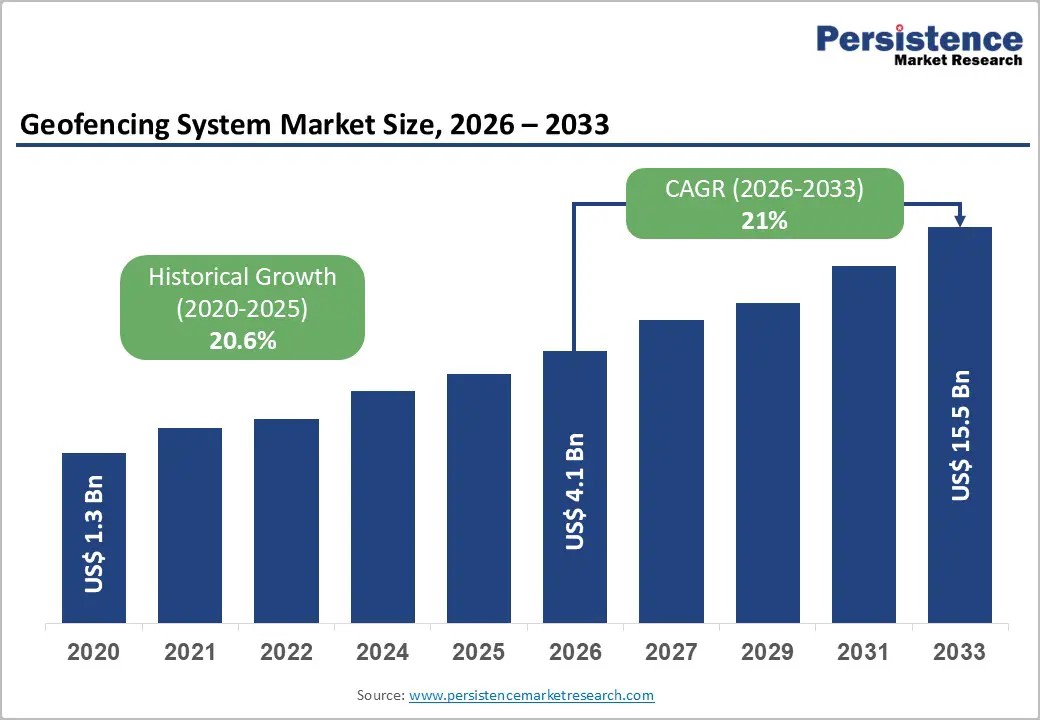
Geofencing market to reach US$15.5 Bn by 2033, driven by location-based marketing, IoT, and fleet tracking, with demand from retail, logistics, & BFSI
BRENTFORD, ENGLAND, UNITED KINGDOM, June 15, 2026 /EINPresswire.com/ -- The global geofencing market is experiencing rapid expansion as organizations increasingly adopt location-based technologies to improve customer engagement, operational efficiency, asset tracking, and security. Geofencing technology creates virtual geographic boundaries around specific locations and triggers automated actions when devices enter or exit these predefined zones. With the widespread adoption of smartphones, connected devices, GPS-enabled systems, and IoT platforms, geofencing has evolved from a niche technology into a critical component of modern enterprise operations.
The global geofencing market size is expected to reach US$ 4.1 billion in 2026 and is projected to grow to US$ 15.5 billion by 2033, registering a robust CAGR of 21% during the forecast period. The market is being driven by the increasing adoption of location-based marketing, fleet and asset management solutions, workforce monitoring, and security applications. Advances in GPS, Bluetooth Low Energy (BLE), Wi-Fi, cellular connectivity, and cloud computing are strengthening the technology ecosystem, enabling more accurate and scalable geofencing deployments. North America currently leads the market with approximately 38% share, while GPS-based geofencing remains the dominant technology segment, accounting for nearly 48% of total market revenue.
𝐆𝐞𝐭 𝐚 𝐒𝐚𝐦𝐩𝐥𝐞 𝐏𝐃𝐅 𝐁𝐫𝐨𝐜𝐡𝐮𝐫𝐞 𝐨𝐟 𝐭𝐡𝐞 𝐑𝐞𝐩𝐨𝐫𝐭: https://www.persistencemarketresearch.com/samples/19891
Key Factors Driving Market Growth
The proliferation of smartphones, wearable devices, connected vehicles, and IoT infrastructure is one of the primary growth drivers for the geofencing market. As billions of connected devices generate real-time location data, businesses are increasingly leveraging geofencing technology to automate processes, personalize customer experiences, and optimize operations. Retailers use geofencing to deliver targeted promotions, logistics providers monitor fleet movements, and enterprises enhance workforce productivity through location-based tracking systems.
Another major growth factor is the increasing adoption of geofencing across logistics and transportation industries. Fleet operators rely on virtual boundaries to monitor vehicle routes, improve delivery accuracy, automate dispatch operations, and ensure compliance with transportation regulations. Geofencing helps businesses reduce operational inefficiencies, improve customer satisfaction, and strengthen supply chain visibility. As logistics networks become more complex, geofencing is becoming a standard feature in transportation management systems and fleet tracking platforms.
Market Segmentation Analysis
The geofencing market is segmented by technology type and geofencing type. GPS-based geofencing leads with around 48% market share in 2026 due to its reliability and widespread use in fleet management, logistics, asset tracking, and mobility services. Meanwhile, Bluetooth Low Energy (BLE) and Ultra-Wideband (UWB) technologies are the fastest-growing segments, driven by increasing demand for precise indoor positioning in retail stores, warehouses, hospitals, and manufacturing facilities.
Based on geofencing type, fixed geofencing holds approximately 54% market share, supported by its extensive use in retail outlets, warehouses, industrial sites, and government facilities. Mobile geofencing is the fastest-growing segment as organizations increasingly adopt dynamic location-based solutions for workforce tracking, route optimization, and real-time asset management.
𝐃𝐨 𝐘𝐨𝐮 𝐇𝐚𝐯𝐞 𝐀𝐧𝐲 𝐐𝐮𝐞𝐫𝐲 𝐎𝐫 𝐒𝐩𝐞𝐜𝐢𝐟𝐢𝐜 𝐑𝐞𝐪𝐮𝐢𝐫𝐞𝐦𝐞𝐧𝐭? 𝐑𝐞𝐪𝐮𝐞𝐬𝐭 𝐂𝐮𝐬𝐭𝐨𝐦𝐢𝐳𝐚𝐭𝐢𝐨𝐧 𝐨𝐟 𝐑𝐞𝐩𝐨𝐫𝐭: https://www.persistencemarketresearch.com/request-customization/19891
Market Drivers
The growing adoption of IoT devices, connected sensors, and telematics systems is a major driver of the geofencing market. Businesses use geofencing to automate operations, improve asset visibility, and enhance decision-making. Additionally, rising demand for location-based marketing enables retailers and brands to deliver personalized promotions and improve customer engagement. Regulatory compliance requirements in transportation, logistics, healthcare, and financial services further support market growth.
Market Restraints
Battery drain caused by continuous GPS tracking remains a key challenge for geofencing adoption. Accuracy limitations in indoor environments and densely populated urban areas can also impact performance, often requiring additional technologies such as Wi-Fi, BLE, and RFID. Furthermore, stringent data privacy regulations, including GDPR and CCPA, increase compliance requirements and create implementation challenges for organizations.
Market Opportunities
The integration of geofencing with autonomous vehicles, drones, and smart city infrastructure presents significant growth opportunities. Geofencing is increasingly being used for traffic management, public safety, and autonomous mobility applications. Additionally, the combination of geofencing with AI, cloud analytics, and digital twins enables predictive insights, automated decision-making, and improved operational efficiency. Growing demand for indoor spatial analytics in retail, healthcare, and warehousing further expands market potential.
Regional Insights
North America dominates the geofencing market with approximately 38% share, driven by strong smartphone penetration, advanced digital infrastructure, and widespread adoption of location-based services. Europe remains a key market due to industrial digitization, smart city initiatives, and strict regulatory frameworks. Asia Pacific is projected to be the fastest-growing region, supported by rapid urbanization, expanding e-commerce, increasing smartphone usage, and government investments in smart city and IoT projects.
Competitive Landscape
The global geofencing market is moderately fragmented, featuring a mix of major technology companies, cloud platform providers, geospatial analytics specialists, and location intelligence startups. Industry leaders focus on expanding platform capabilities through AI integration, advanced analytics, privacy-enhancing technologies, and seamless integration with enterprise software ecosystems.
Key companies operating in the geofencing market include:
• Google LLC
• Apple Inc.
• Microsoft Corporation
• IBM Corporation
• Bluedot
• Radar Labs, Inc.
• ESRI
• Foursquare Labs Inc.
• Gimbal
• HERE Technologies
• Verizon Connect
• Samsara
• SZ DJI Technology Co. (DJI)
𝐁𝐮𝐲 𝐍𝐨𝐰 𝐭𝐡𝐞 𝐃𝐞𝐭𝐚𝐢𝐥𝐞𝐝 𝐑𝐞𝐩𝐨𝐫𝐭: https://www.persistencemarketresearch.com/checkout/19891
Future Outlook
The future of the geofencing market will be shaped by increasing integration with artificial intelligence, edge computing, IoT platforms, and autonomous systems. As businesses seek more sophisticated location intelligence capabilities, geofencing will evolve beyond simple perimeter alerts toward predictive analytics, behavioral insights, and automated decision-making frameworks. Advances in indoor positioning technologies and privacy-preserving data architectures will further expand adoption across industries.
Conclusion
The global geofencing market is entering a period of substantial growth, driven by the increasing adoption of location-based services, connected devices, and digital transformation initiatives across industries. Businesses are recognizing the value of geofencing in enhancing customer engagement, improving operational efficiency, strengthening security, and enabling real-time decision-making. While challenges related to privacy, accuracy, and infrastructure complexity persist, ongoing technological advancements and expanding application areas continue to create significant growth opportunities. With North America maintaining market leadership and Asia Pacific emerging as a high-growth region, the geofencing market is poised to become a cornerstone of future location intelligence and smart infrastructure ecosystems through 2033.
Related Reports:
Smart Home Cloud Platform Market
Pooja Gawai
Persistence Market Research
+1 646-878-6329
email us here
Visit us on social media:
LinkedIn
Instagram
Facebook
YouTube
X
Legal Disclaimer:
EIN Presswire provides this news content "as is" without warranty of any kind. We do not accept any responsibility or liability for the accuracy, content, images, videos, licenses, completeness, legality, or reliability of the information contained in this article. If you have any complaints or copyright issues related to this article, kindly contact the author above.
