

Global Optical Fiber-Embedded Textile Yarns Market Set for Strong Growth Through 2036 at Double-Digit CAGR
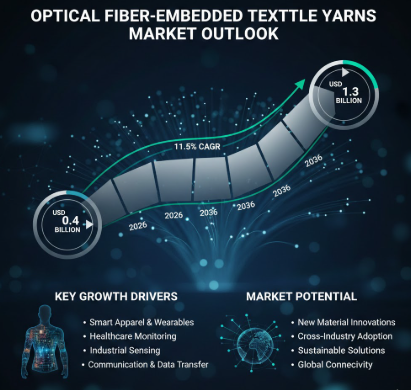
Press release outlines key trends, drivers, global forecasts, and industry relevance for the optical fiber-embedded textile yarns market.
NEWARK, DE, UNITED STATES, February 4, 2026 /EINPresswire.com/ -- The global optical fiber-embedded textile yarns market is projected to expand significantly over the next decade, with the market valued at USD 0.4 billion in 2026 and forecast to reach approximately USD 1.3 billion by 2036, underpinned by rising adoption in smart textiles, apparel illumination, and performance fabrics. This analysis, based on industry research from Future Market Insights, highlights sustained growth driven by technological integration across textile and design sectors worldwide.
Who: The market includes manufacturers, textile integrators, smart textile designers, and end-users in fashion and performance apparel, interior textiles, automotive soft signage, and other functional fabrics. Key players shaping the competitive landscape include established materials and technology firms with expertise in optical fiber and textiles.
What: Optical fiber-embedded textile yarns are engineered yarns with integrated optical fibers that enable illumination, data transmission, safety signaling, and aesthetic effects in fabrics. These advanced yarns serve both functional and design-driven applications in smart and connected textiles.
When: Market forecasts cover the period between 2026 and 2036, offering a long-term view of growth trends, adoption patterns, and competitive dynamics.
Where: Adoption spans global regions, with notable momentum in Asia-Pacific, North America, Europe, and key emerging markets where fashion technology and smart textile manufacturing ecosystems are expanding.
Why: Growth is driven by escalating demand for innovative textile solutions that combine aesthetics and function, particularly in performance apparel and illumination-rich applications. Manufacturers benefit from polymer optical fiber’s flexibility and light transmission capabilities and growing infrastructure investment in smart textiles.
How: Integration of optical fibers into yarns will be accomplished through manufacturing processes that enhance light uniformity, signal transmission, and textile compatibility. Adoption is supported by investments in advanced textile processing infrastructure and R&D focused on ready-to-weave formulations.
Market Context and Insights
Growth Forecast and Key Metrics
Industry projections indicate the optical fiber-embedded textile yarns market will grow from USD 0.4 billion in 2026 to approximately USD 1.3 billion by 2036, reflecting increased utility across industries that value illuminated, data-enabled, or communicative textiles.
Data suggest double-digit compounded annual growth, propelled by enhancements in fiber design and wider adoption of smart fabric technologies, positioning this market at the intersection of textile innovation and functional material demand. This trend aligns with broader growth in connected fabrics and integrated textile solutions.
Segment and Application Drivers
Leading applications include fashion and performance apparel, where integrated optical fibers enable designer lighting effects, improved functionality, and heightened aesthetic appeal. These segments act as primary demand pools for advanced textile manufacturers and brands.
Other faster-adopting use cases include interior and automotive textiles that require illumination or signaling capabilities, and soft signage where aesthetic integration meets practical functionality.
Industry Relevance and Competitive Landscape
Technology and Innovation Trends
• The shift toward ready-to-weave optical fiber yarns reduces complexity in production and extends use across textile platforms.
• Development of multifunctional optical fiber yarns supports illumination, data transmission, and safety signaling within a single textile system.
These trends reflect broader industry priorities around supply chain efficiency, textile modularity, and material performance consistency, which are increasingly important to apparel OEMs and integrated textile brands.
Competitive and Regional Dynamics
The competitive landscape includes both traditional textile specialists and materials innovators, with players increasingly focusing on R&D partnerships and cross-industry collaborations to enhance product performance and market penetration.
Regional growth drivers emphasize strong demand and manufacturing capabilities in Asia-Pacific markets, complemented by advanced design and technology integration in North America and Europe.
Market Challenges and Mitigating Factors
While growth prospects are substantial, the market faces challenges including higher procurement costs and the technical complexity of integrating optical components into existing textile production lines. Ongoing innovation and supply chain optimization are critical to overcoming these barriers.
Request for Sample Report | Customize Report |purchase Full Report – https://www.futuremarketinsights.com/reports/sample/rep-gb-31805
Explore More Related Studies Published by FMI Research:
Condensing Unit Market https://www.futuremarketinsights.com/reports/condensing-unit-market
Lubricant Additives Market https://www.futuremarketinsights.com/reports/lubricant-additives-market
Ferric Sulfate Market https://www.futuremarketinsights.com/reports/ferric-sulfate-market
About Future Market Insights (FMI)
Future Market Insights, Inc. (FMI) is an ESOMAR-certified, ISO 9001:2015 market research and consulting organization, trusted by Fortune 500 clients and global enterprises. With operations in the U.S., UK, India, and Dubai, FMI provides data-backed insights and strategic intelligence across 30+ industries and 1200 markets worldwide.
Why Choose FMI: https://www.futuremarketinsights.com/why-fmi
Sudip Saha
Future Market Insights Inc.
+1 347-918-3531
rahul.singh@futuremarketinsights.com
Legal Disclaimer:
EIN Presswire provides this news content "as is" without warranty of any kind. We do not accept any responsibility or liability for the accuracy, content, images, videos, licenses, completeness, legality, or reliability of the information contained in this article. If you have any complaints or copyright issues related to this article, kindly contact the author above.
